

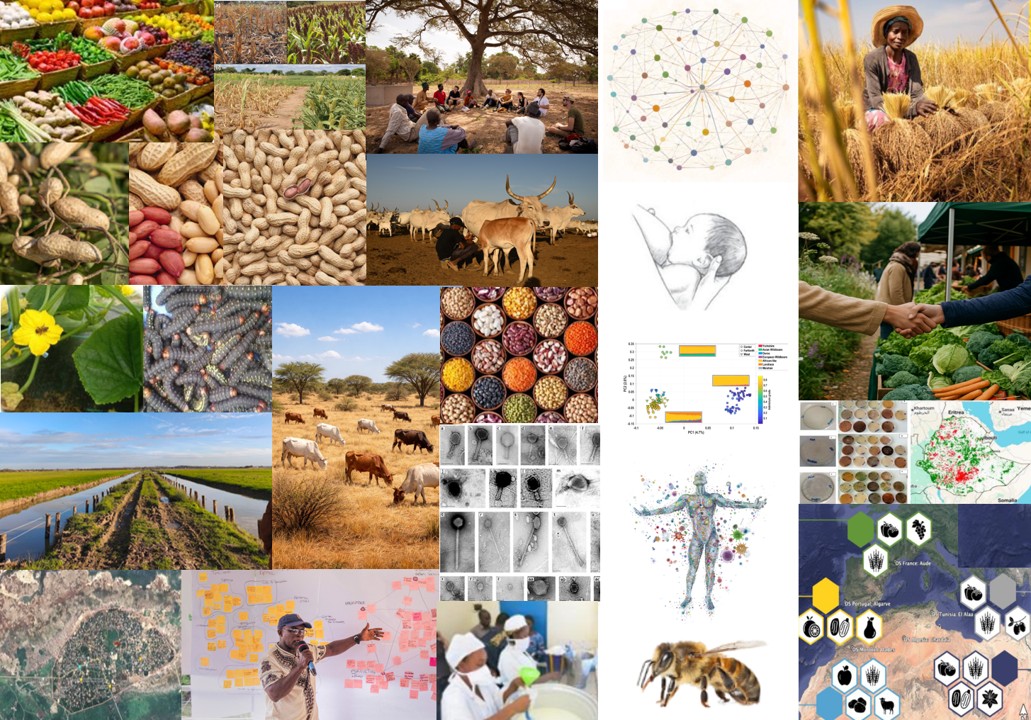
The proceedings from the 1st TSARA Science Days are now available!
-
by
TSARA
In January 2026, these scientific sessions brought together the TSARA community for four webinars focused on agroecological transitions, sustainable food systems, and their interactions. The goal was to share knowledge, findings, and research related to TSARA, identify future directions, and strengthen the dialogue between researchers and partners.
Find the proceedings here that highlight lessons learned regarding science, approaches, projects, and partnerships.
Participants, authors, and experts agreed on the approaches to develop and the levers to promote in order to achieve the desired impact: agroecology is considered an effective path toward transforming food systems through the preservation and enhancement of local resources, knowledge, and products, as well as collective and equitable action at the local level. A wide variety of agroecological practices and technological, product, or organizational innovations that contribute to improving food and nutritional security were presented. Various levers to be activated and coordinated were highlighted: multi-stakeholder governance, participatory knowledge ecosystems, science-policy dialogue and interfaces, training for all stakeholders, and scientific research.
TSARA, a “research community, platform, and hub of knowledge and expertise,” aims to build on these directions and organize a new edition in 2027!
SUMMARY
TSARA is a collaborative research initiative that, through networking, the sharing of knowledge and practices, and the co-development of projects, aims to support the transition toward productive, resilient, sustainable, and inclusive food systems, contributing to food and nutritional security and to the creation of value and jobs, while preserving resources and global health.
With this in mind, the 1st TSARA Science Days, held virtually in January 2026, aimed to: (i) share knowledge on agroecological transition, sustainable food systems, and the interactions between agroecology and food systems; (ii) foster dialogue among researchers based on their concrete work, and strengthen and expand the TSARA scientific community; and (iii) identify and discuss avenues for further work.
The event brought together over 400 participants, including 71 project leaders, Ph.D. students, and senior researchers from Africa and Europe, working across a wide range of disciplines and themes.
Participants, authors, and experts agreed on the approaches to be developed and the levers to be promoted in order to achieve the targeted impact.
Agroecology, a systemic approach that combines a range of agricultural practices and also addresses issues of local governance, is regarded as an effective tool for transforming food systems: the promotion of local knowledge, collective action, and the joint development of strategies tailored to the local context, environmentally friendly production practices, the efficient use of resources, the strengthening of resilience, the improvement of social equity, short supply chains and the promotion of local produce, the steering of consumption patterns, the strengthening of local autonomy, and the relocalization of supply chains.
A variety of agroecological practices are presented—including animal and plant genetic diversity, diversification of production and activities, soil, plant, and animal health, biological control, pastoralism, water management, and circularity—from the perspectives of modeling, epidemiology, genetics, and other fields. Climate change and climate variability are explored in the majority of the studies presented.
In the field of food systems, the exhibition showcases innovations, practices, technologies, products, processes, strategies, and policies that contribute to improving food and nutritional security: the processing of plant and animal products, including pulses and edible insects; fermentation; freezing; infant nutrition; post-harvest technologies; the cold chain; market development; water management; trade; and the interconnections between food, water, and energy.
To effectively support the transition toward sustainable food systems, various measures must be implemented and coordinated:
- multistakeholder governance capable of collaboratively shaping pathways at the local level in an inclusive manner, connecting producers and consumers;
- participatory knowledge ecosystems that bring together research, training, practitioners in the field, and public institutions, linking local knowledge with scientific knowledge; research can play a role in informing decisions and acting as a mediator;
- in-depth scientific research into the principles and performance of agroecology, risk-sharing mechanisms, multidimensional and multidisciplinary approaches to food and the trade-offs between these dimensions (culture, economy, environment, short- and long-term perspectives, gender), the link between
10
agrobiodiversity, nutrition, and the microbiome, and the interfaces between participatory approaches and modeling tools to support decision-making processes, as well as appropriate digital technologies and data; - fostering dialogue and science-policy interfaces to support coherent, coordinated, and favorable policies;
- strengthening training —both initial and continuing—for all stakeholders in agroecology, systems thinking, the interrelationship between food, nutrition, and the environment, and appropriate multi-criteria systems.
TSARA is committed to addressing these priorities. As a “research community, platform, and hub of knowledge and expertise,” TSARA must, through networking and in synergy with existing initiatives:
- consolidate its participatory research approach , which is both comprehensive and rooted in the local community, drawing on living labs;
- develop training initiatives , student engagement, and support;
- summarize its findings, communicate them, and share them with a wider audience;
- focus on the science-policy interface at various levels, particularly within the framework of the African Union–European Union dialogue, in relation to African governments and multinational partners;
- help convince decision-makers and the private sector of the importance of supporting research and securing funding;
- continue and expand the provision of spaces for scientific exchange and interaction.
The outcome of this first edition of the TSARA Science Days is positive in terms of i) engagement and partnership dynamics (teamwork, significant and diverse participation, mutual understanding and strengthening of the TSARA community, and a commitment to continue), ii) format and organization, iii) content (thematic and disciplinary diversity, richness, interest, and practical relevance of the work presented, particularly regarding agroecology, though less so regarding the interaction between agroecology and food systems). Areas identified for improvement include the high density of sessions, time management pressures, and the limited space for discussion.
The expected follow-up actions focus on consolidating communities of practice, developing new collaborations among authors, building networks—particularly among Ph.D. students—organizing thematic exchanges, and promoting the content (publications, working groups, training courses).
The upcoming Science Days have received widespread support: held in person (or in a hybrid format) over several days, they facilitate in-depth interaction and discussion, with opportunities to share experiences, participate in project-based workshops, and organize award ceremonies; they are aimed at a multistakeholder audience—researchers from the public and private sectors, students, farmers, civil society, decision-makers, and donors—and cover topics such as climate change adaptation, digital agriculture, agricultural employment, biodiversity conservation, water management/ReUSE, One Health for food security, and the evaluation of public policies.
